
A Complete Checklist Before Finalising a Retirement Home

Finalising a retirement home is not just a housing decision — it is a life decision. Families often visit one or two properties, feel reassured by brochures or hospitality, and make a quick choice. Unfortunately, many problems surface after the move-in: hidden costs, inadequate care, unclear exit clauses, or emotional discomfort for the senior. This blog provides a practical, step-by-step checklist families can use before finalising any retirement home in Bengaluru, helping avoid regret and ensuring dignity, safety, and peace of mind.
Step 1: Assess the Senior's Real Needs (Not Assumptions)
Before evaluating properties, be clear about the senior's current and near-future needs.
- Ask yourself honestly: Is the senior fully independent today?, Is mobility limited or declining?, Are medications managed reliably?, Are there memory or confusion issues?, Is loneliness or anxiety a concern?
- Key insight: Choosing a home that matches today's needs + tomorrow's risks is crucial.
Step 2: Understand the Type of Retirement Home
Not all retirement homes offer the same level of care.
- Common categories: Independent senior living, Assisted living, Old age homes (care-focused), Dementia or memory care homes, Hybrid / continuum-of-care communities
- Always ask: What level of care is included today?, What additional care can be added later?
Step 3: Physical Safety & Accessibility Checklist
During your visit, observe carefully.
- Inside the living unit: Step-free entry, Anti-skid flooring, Grab bars in bathrooms, Emergency call button, Adequate lighting
- Common areas: Ramps and handrails, Lift availability and backup, Slip-resistant corridors, Clearly marked signage
- Important note: If a home is not senior-friendly physically, emotional comfort will also suffer.
Step 4: Medical & Emergency Support
This is non-negotiable.
- Confirm clearly: Is a nurse available on-site? (hours & days), Doctor visit frequency, Hospital tie-ups (which hospital, how far), Ambulance availability (on-call or dedicated), Emergency escalation process
- Pro tip: Ask for real scenarios, not generic assurances.
Step 5: Staffing & Care Quality
Care quality depends on people, not buildings.
- Ask management: Caregiver-to-resident ratio, Training provided to caregivers, Staff turnover rate, Night-time supervision arrangements, Language comfort (important for seniors)
- Best practice: Whenever possible, observe staff interactions with residents.
Step 6: Food, Nutrition & Daily Routine
Food is both health and emotion for seniors.
- Check: Are meals freshly prepared on-site?, Is the food senior-friendly and nutritious?, Flexibility for diabetic / low-salt diets, Meal timings and portion options, Opportunity to sample a meal
- Insider tip: Ask residents quietly what they feel about food quality.
Step 7: Community Life & Emotional Wellbeing
A retirement home should feel like a community, not a facility.
- Look for: Group activities (yoga, music, games), Celebration of festivals and birthdays, Outdoor time and walking spaces, Quiet zones for seniors who prefer calm, Respect for privacy and personal routines
- Warning: Loneliness can exist even in premium homes — watch carefully.
Step 8: Cost Structure & Transparency
This is where many families face surprises.
- Demand clarity on: Monthly fees (what is included and excluded), One-time deposits (refundable or not), Escalation clauses, Charges for additional caregivers or nursing, Medical costs not included
- Action required: Ask for everything in writing.
Step 9: Contract, Exit & Refund Clauses
Never skip this step.
- Review carefully: Minimum stay requirements, Exit notice period, Refund timelines, Conditions under which refund is reduced, Transfer or inheritance clauses
- Legal advice: If needed, consult a lawyer — especially for high deposits.
Step 10: Trial Stay & Final Decision
Whenever possible:
- Opt for: A trial stay (7–30 days), Observe emotional adjustment, Check sleep, appetite, and mood, Speak openly with the senior
- Reality check: A home that looks good on paper may not feel right emotionally.
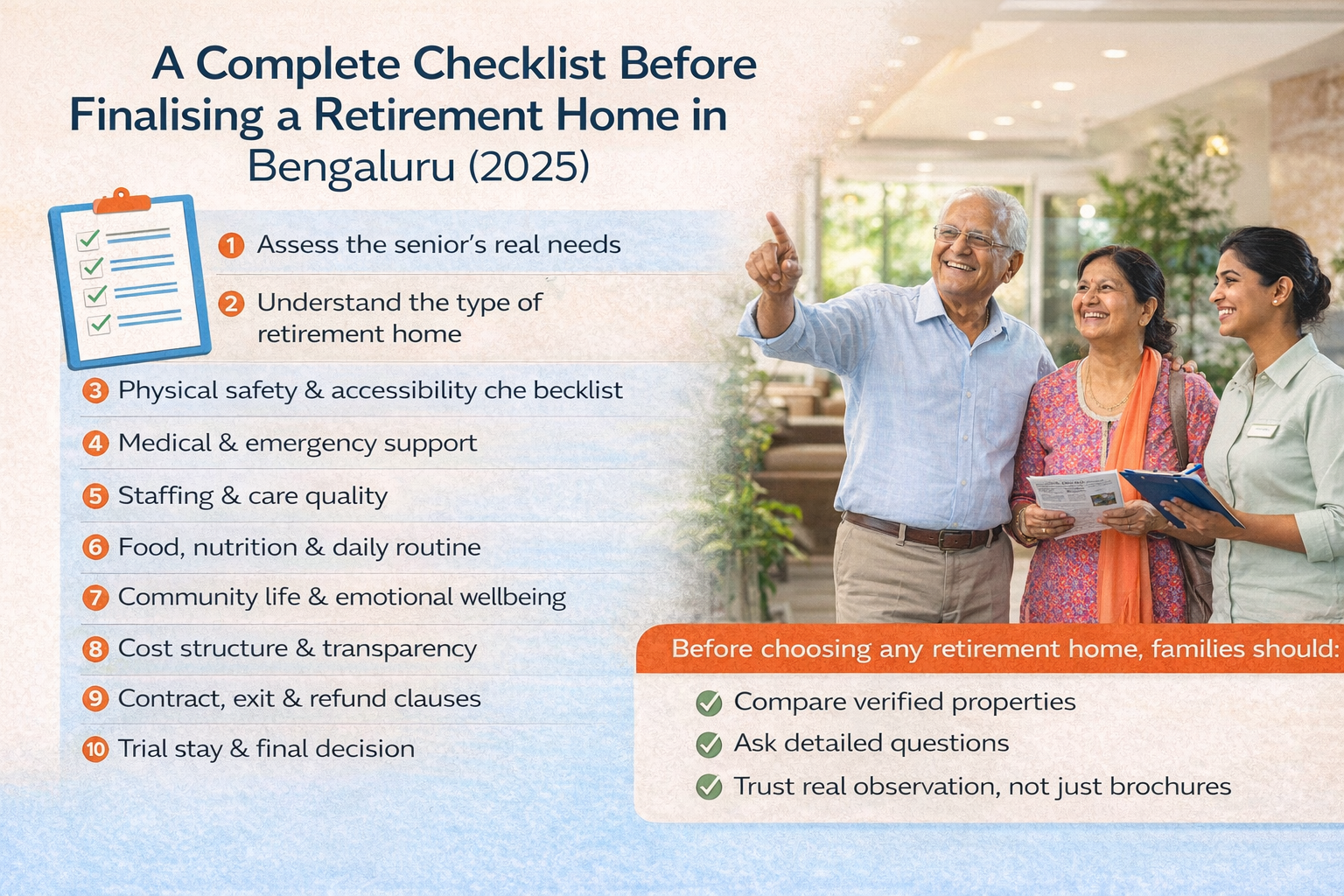
Trial stays help seniors and families make informed retirement home decisions in Bengaluru
Common Red Flags to Watch Out For
Be cautious if you notice:
- Reluctance to share contracts upfront
- Vague answers to medical questions
- Overcrowded caregiving staff
- Excessive sales pressure
- Lack of resident interaction
How Ad1tage Helps Families Avoid Costly Mistakes
At ad1tage.com, families can:
- Compare verified retirement homes objectively
- Understand care models and pricing clearly
- Shortlist homes that match real needs
- Avoid rushed or sales-driven decisions
- Access neutral, senior-first guidance
Choosing the right retirement home takes time — and that time is well spent. A thoughtful decision ensures seniors live with safety, dignity, emotional comfort, and respect, while families gain long-term peace of mind.
More Blog Posts
A Complete Guide to Choosing a Retirement Home in Bengaluru
Finding the right retirement home is one of the most important decisions for seniors and their famil...
Founders Journey: From experiencing and Identifying Needs to Creating Solutions at ad1tage.com
Over the past three decades, my quest for effective solutions following my mother's chronic illness,...
Doctors and Psychologists in Elder Care: The Medical & Emotional Support Seniors Deserve
Ageing gracefully isn't just about comfort — it's about care. Behind every healthy senior is a suppo...
