
5 Signs Your Parent May Need Extra Support — Before a Crisis

There is often a moment when adult children begin to wonder: “Is Mum really managing on her own?” Or: “Is Dad still able to manage everything safely?” The difficulty is that ageing rarely comes with a clear warning. There may not be one dramatic event that tells a family that support is needed. Instead, there are small changes. A missed appointment. An untidy home. A parent who stops going out. A fall that is described as “nothing serious.” A growing dependence on neighbours or relatives for things they once managed themselves. Individually, these signs may not seem significant. Together, they may be telling us something important: it may be time to offer a little more support. And offering support does not necessarily mean taking away independence. Sometimes, the right support is what helps a senior remain independent for longer.
1. Everyday Tasks Are Becoming Difficult
One of the earliest signs is often a change in how everyday activities are managed. Perhaps your parent once handled all of these without any assistance:
- Grocery shopping
- Cooking
- Cleaning
- Banking
- Paying bills
- Managing appointments
- Household maintenance
- Now you notice that some of these tasks are being postponed, avoided, or delegated. It does not necessarily mean your parent cannot manage — it may simply mean some tasks are becoming more tiring or inconvenient.
- What families can do: Instead of immediately taking over everything, ask, “Which things are becoming difficult? Is there anything we can make easier?” That keeps the conversation focused on support rather than dependence.
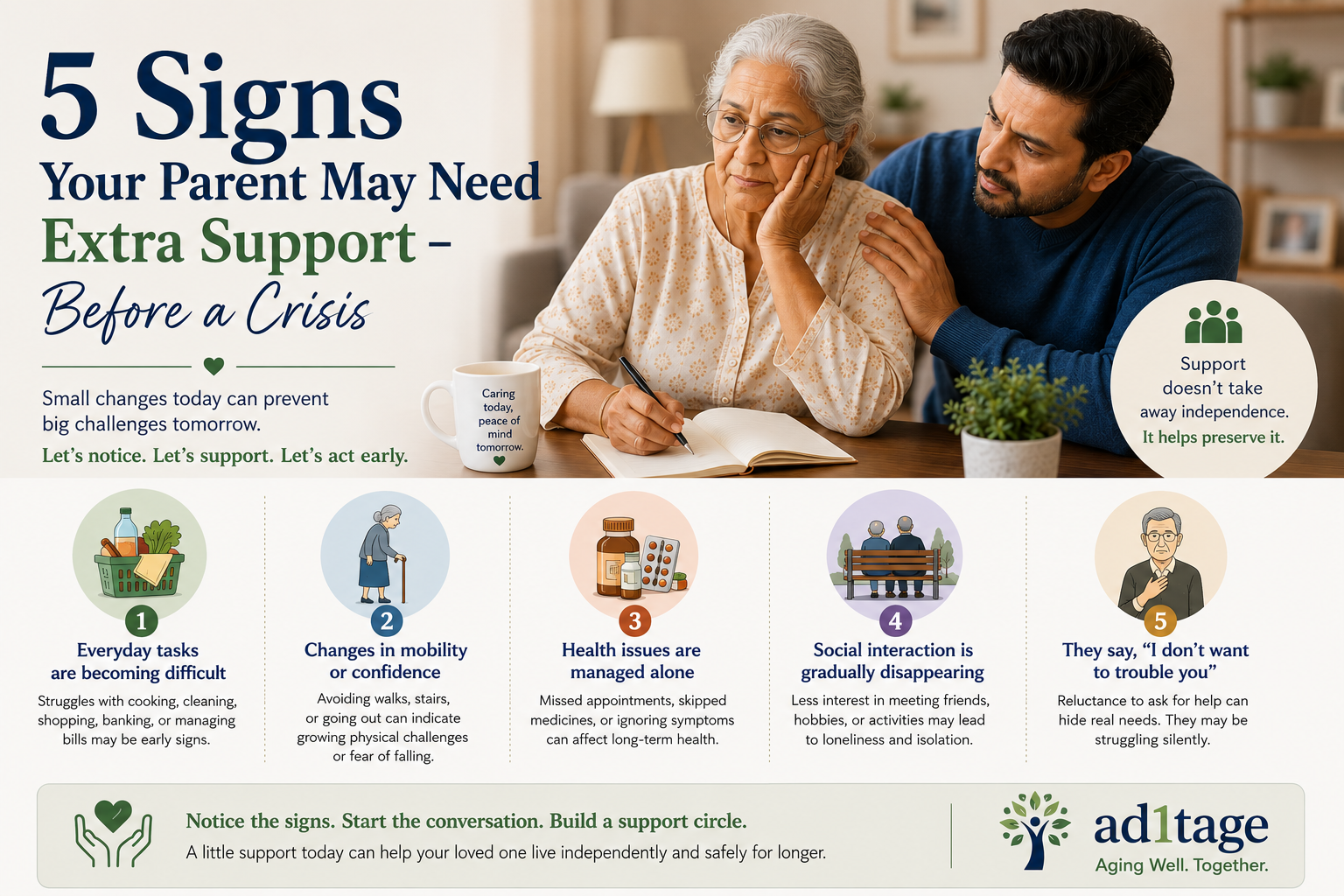
The signs are often small and everyday — which is exactly why they are so easy to miss.
2. There Are Changes in Mobility or Confidence
Sometimes the change is subtle. Your parent may:
- Avoid stairs
- Stop going for walks
- Hold on to furniture while moving around
- Become nervous about going outside
- Avoid driving
- Stop attending social activities
- The important point is not simply whether they have fallen. It is whether fear of falling or reduced confidence is beginning to change their behaviour. A senior who stops doing activities out of fear may gradually become less active, which can create further difficulties.
- What families can do: A conversation with a doctor or physiotherapist may help determine what support or adjustments are appropriate. Sometimes a few simple changes can make a significant difference.
3. Health Issues Are Being Managed Alone
A parent may say, “It’s nothing. I’ll manage.” But repeated small issues deserve attention. For example:
- Medical appointments being postponed
- Medicines being missed
- Recurring symptoms being ignored
- Difficulty following treatment instructions
- Increasing fatigue
- Poor appetite or changes in eating habits
- One missed appointment may mean nothing. A pattern deserves a closer look.
- What families can do: Ask about health without making the conversation sound like an interrogation. Instead of “Why didn’t you go to the doctor?” try “Would you like me to help arrange the appointment?” The second approach feels supportive rather than critical.
4. Social Interaction Is Gradually Disappearing
This sign is particularly easy to miss. A parent who once met friends, attended religious or community activities, went shopping, enjoyed hobbies, or spoke regularly with neighbours may gradually stop doing these things. Sometimes the explanation is simply, “I don’t feel like going.” Again, one missed outing isn’t necessarily a concern. But when a person’s social world becomes progressively smaller, it is worth paying attention. Why it matters: Social connection is an important part of wellbeing. Support does not always have to mean a caregiver. Sometimes it means:
- A regular phone call
- A weekly visit
- A walking companion
- A hobby group
- A senior community
- A neighbour checking in
- The objective is connection, not supervision.
5. Your Parent Starts Saying, “I Don’t Want to Trouble You”
This may be one of the most important signs of all. Parents often spend their lives looking after their children. As they grow older, some become reluctant to ask for help because they are afraid of becoming a burden. You may hear:
- “Don’t worry about me.”
- “I’ll manage.”
- “You have enough to deal with.”
- “I didn’t want to trouble you.”
- These words should not automatically be interpreted as a problem. But sometimes they hide a genuine need for support.
- What families can do: Make it clear that asking for help is not an inconvenience. Tell them, “You don’t have to manage everything alone. Let’s figure out what would make things easier.” That can open a much more meaningful conversation.
What If You Notice More Than One Sign?
This is where families should pause. You don’t need to immediately decide, “We need a caregiver,” or, “We need assisted living.” There are many levels of support. It could begin with:
- Regular family check-ins
- A trusted neighbour
- Home delivery services
- Help with transportation
- A caregiver for a few hours
- A regular doctor’s home visit
- Physiotherapy
- A senior activity group
- A local support network
- The right solution depends on the individual.
Support Does Not Mean Taking Away Independence
This is perhaps the most important message for families. A senior may need assistance with cooking but still be perfectly capable of managing their finances. They may need help getting to appointments but still want complete independence at home. They may benefit from a weekly check-in without wanting a full-time caregiver. Support should be proportionate to need. The goal should not be to take control. The goal should be to make independent living safer and more sustainable.
Don't Wait for the Crisis
Families often start planning only after something happens — a fall, a hospitalisation, a missed medication, a caregiver emergency. But planning before a crisis gives everyone more choices. It allows families to ask:
- What support would Mum actually accept?
- Who can help locally?
- Which doctor should we contact?
- What happens if there is an emergency?
- Who can accompany a parent to the hospital?
- Where are important medical records?
- Who should have access to emergency contacts?
- These conversations may feel uncomfortable. But they are much easier to have when everything is going well.
A Support Circle Can Start Small
A support circle does not have to be a large organisation. It can begin with five people. Perhaps: family + neighbour + doctor + caregiver + trusted friend. Each person may have a different role. One person checks in. Another helps with medical appointments. Someone else can respond if there is an emergency. The family remains at the centre. This is particularly valuable when children live in another city.
A Lesson From Our Pilot
A recent experience reinforced this for us. A senior associated with our pilot contacted us because an 86-year-old relative had suffered a fall and needed a doctor’s visit at home. The challenge was not simply finding medical care. It was coordinating the help that was needed at that moment. With the support of a healthcare partner, we were able to coordinate a doctor’s visit. It was a small intervention. But it demonstrated something important: a support system becomes valuable when it can turn concern into action.
How Ad1tage Can Help
At Ad1tage, our objective is to help seniors and families discover information, services, and support resources that can make ageing safer and more manageable. We believe that families should have access to information before they face a crisis. That is why we are gradually building a network of senior-care providers, healthcare professionals, communities, and support resources. Our vision is simple: help families recognise needs early, find appropriate support, and help seniors continue ageing with dignity and independence.
A Simple Question for Every Family
Perhaps every family with ageing parents should occasionally ask, “Is everything still manageable, or is there something we could make easier?” Not, “What can you no longer do?” But, “What would make life a little easier?” That change in language can make a world of difference.
Ageing does not suddenly make someone dependent. Needs often change gradually. The earlier families notice those changes, the more choices they have. And support does not have to mean giving up independence. Sometimes it simply means having someone nearby when needed. A little help. A regular check-in. A trusted doctor. A supportive neighbour. A reliable caregiver. A family that knows what to do. Because the best time to build a support system is before you need one. Explore senior care options and build your support circle on Ad1tage: https://ad1tage.com/
More Blog Posts
A Complete Guide to Choosing a Retirement Home in Bengaluru
Finding the right retirement home is one of the most important decisions for seniors and their famil...
Founders Journey: From experiencing and Identifying Needs to Creating Solutions at ad1tage.com
Over the past three decades, my quest for effective solutions following my mother's chronic illness,...
Doctors and Psychologists in Elder Care: The Medical & Emotional Support Seniors Deserve
Ageing gracefully isn't just about comfort — it's about care. Behind every healthy senior is a suppo...
